A combi (combination) boiler heats your radiators and makes hot water on demand, with no hot water tank and no loft tank. For most London flats and small to medium houses, it’s a space-saving, efficient choice. A like-for-like replacement typically costs around £2,300 to £3,800 in London, takes about one day, and a well-maintained boiler lasts 10 to 15 years. The main limit is hot water flow: most combis struggle to run two showers at once.
This guide covers how combi boilers work, what size you need, what installation involves, what goes wrong, and what they cost to run. It’s written for London homeowners, landlords and tenants who want a straight answer before booking an engineer.
Key Takeaways
- A combi boiler heats water only when you open a tap, so there’s no cylinder to store or reheat.
- Most London flats and 1 to 3 bedroom homes suit a 24kW to 35kW combi.
- Plan on £2,300 to £3,800 for a standard replacement in London. Moving the boiler or converting from a tank system costs more.
- London’s hard water causes limescale, one of the biggest reasons combis lose efficiency.
- Larger homes with two or more bathrooms usually work better with a system boiler.
- Only a Gas Safe registered engineer can legally install or repair a gas boiler.
What Is a Combi Boiler?
A combi boiler is a single gas boiler that provides central heating and instant hot water without a separate hot water cylinder or cold water tank. It takes cold water straight from the mains, heats it when you turn on a tap or shower, and sends hot water to your radiators when the heating is on.
This is why combi boilers dominate the UK domestic market, especially in London flats where storage space is tight. A traditional setup needs a hot water cylinder, a cold water tank in the loft and often a separate boiler. A combi replaces all of that with one wall-mounted unit, usually in a kitchen cupboard or utility space.
Combi boiler vs other boiler types (quick view):
| Boiler type | Hot water tank? | Loft tank? | Best for |
|---|---|---|---|
| Combi | No | No | Flats, small to medium homes, 1 bathroom |
| System | Yes (cylinder) | No | Larger homes, 2+ bathrooms |
| Regular (heat-only) | Yes (cylinder) | Yes | Older homes with existing tank systems |
How Does a Combi Boiler Work?
A combi boiler works by switching between two jobs: heating water for your radiators, or heating water for your taps. Hot water always takes priority.
Here’s what happens inside:
- You open a hot tap. A flow sensor detects water moving through the boiler.
- The boiler stops heating the radiators. A diverter valve redirects power to hot water.
- The burner ignites. Gas burns and heats the heat exchanger.
- Mains water passes through a plate heat exchanger. It picks up heat almost instantly and flows to your tap.
- You close the tap. The boiler switches back to central heating if the thermostat calls for it.
Because the boiler heats water on demand, you never run out of hot water. Flow is limited by the boiler’s output and your mains supply. A short interruption to your radiators while you shower is normal, and most people never notice it.
Condensing technology: Modern combis are condensing boilers. They capture extra heat from exhaust gases, which lets them reach efficiencies above 90%. This produces acidic condensate that drains away through a small plastic pipe, and that pipe is a common failure point in winter (more on that below).
Are Combi Boilers Good for London Homes?
Yes, for most London properties. Combi boilers suit flats and small to medium houses with one or two bathrooms and reasonable mains water pressure.
London housing is a big reason combis are so popular here:
- Flats and maisonettes: Space is limited, and there’s often no loft for a cold water tank. A combi frees up the airing cupboard.
- Victorian and Edwardian terraces: Removing an old cylinder and loft tank gives you room back. It also removes the risk of a tank leaking through the ceiling.
- New builds and conversions: Many already have mains-fed systems designed for combis.
When a combi may not be the best fit:
- Homes with three or more bathrooms
- Properties with poor mains pressure or flow (common in some upper floors of tall buildings)
- Households where several people regularly shower at the same time
- Large houses with high hot water demand
Check with your building management if you live in a leasehold flat. Some freeholders require permission for a new flue route or boiler relocation.
What Size Combi Boiler Do I Need?
Most London homes need a combi boiler between 24kW and 35kW. The right size depends mainly on how much hot water you use at once, not just the number of bedrooms.
For a combi, the kW rating mostly reflects hot water output. Central heating demand in most homes is far lower, and modern boilers adjust their output to match (called modulation).
General sizing guide:
| Property type | Bathrooms | Typical combi size |
|---|---|---|
| 1 bedroom flat | 1 | 24kW to 25kW |
| 2 bedroom flat or house | 1 | 25kW to 30kW |
| 3 bedroom house | 1 | 30kW to 35kW |
| 3 to 4 bedroom house | 2 | 35kW or consider a system boiler |
Things that affect sizing:
- Number of people in the home: A family of five uses far more hot water than a couple.
- Mains water flow rate: A big boiler can’t deliver more than your supply allows.
- Heat loss of your home: Well-insulated flats need less heating output than draughty period houses.
- Number of showers and taps used at once.
A good engineer will carry out a heat loss calculation and check your mains flow rate before recommending a size. Be cautious of anyone who quotes “35kW, just to be safe.” An oversized boiler can cost more upfront and may not run any better.
Example: A 2 bedroom flat in Zone 2 with one bathroom, two adults and a mixer shower is typically well served by a 25kW or 30kW combi.
Can a Combi Boiler Run Two Showers?
Usually not at full performance. A standard combi can run two outlets at once, but the flow and temperature drop, so two showers together are rarely comfortable.
The reason is flow rate. A 30kW combi delivers around 12 litres of hot water per minute at a typical temperature rise. A 35kW combi gets closer to 14 litres per minute. A standard mixer shower uses roughly 8 to 10 litres per minute, and a rainfall head can use more.
What this means in practice:
- One shower plus a kitchen tap: usually fine
- Two showers together: weak flow or lukewarm water
- Shower plus a running bath: expect a noticeable drop
Options if you need two showers at once:
- Choose a system boiler with an unvented cylinder, which stores a large volume of hot water
- Install a 35kW combi and use water-efficient shower heads (lower-flow heads help stretch capacity)
- Upgrade your incoming mains if flow is poor (a water company or plumber can advise)
Can a Combi Boiler Supply Two Bathrooms?
A combi can supply two bathrooms, but not two showers at once. It works best when different people use the bathrooms at different times.
The boiler produces the same amount of hot water whether it serves one bathroom or five. So a 35kW combi in a 2 bathroom flat may be fine if a couple lives there. In a family home with teenagers, a stored-water system is usually the better choice.
A combi for two bathrooms may work if:
- Only one shower or bath is used at a time
- Your mains flow rate is strong (ideally around 15 litres per minute or more)
- The second bathroom is a small en-suite or a toilet and basin
Choose a system boiler if:
- Two or more showers are used at the same time
- You have a bath and a shower in regular simultaneous use
- Your home has three bathrooms or more
What Is the Best Boiler for a Small House?
For a small house (1 to 2 bedrooms, one bathroom), a 24kW to 30kW combi boiler from a reputable manufacturer is usually the best choice. It’s compact, efficient and avoids the need for a cylinder.
What to look for:
- Output that matches your needs: 24kW or 25kW for a 1 bedroom home, 25kW to 30kW for a 2 bedroom home
- A long warranty: Many major brands offer 5 to 10 years when installed by an approved installer
- High efficiency: Look for an ErP rating of A
- A compact size: Useful for kitchen cupboards and utility rooms
- Compatible smart controls: Good controls can reduce gas use without reducing comfort
Well-known brands include Worcester Bosch, Vaillant, Viessmann, Ideal and Baxi. Reliability depends on correct installation and regular servicing at least as much as on the badge on the front.
Installing a Combi Boiler in London: What to Expect
A standard like-for-like combi replacement in London takes about one day. Moving the boiler or converting from a tank system usually takes two to three days.
Installation Cost in London
Typically, a combi boiler installation in London costs between £2,300 and £3,800 for a standard replacement, including the boiler, labour and a new flue if needed. Prices vary by brand, size and the work involved.
| Job type | Typical London price range | Typical time |
|---|---|---|
| Like-for-like combi replacement | £2,300 to £3,800 | 1 day |
| Combi replacement, boiler moved | £3,000 to £4,500+ | 1 to 2 days |
| System or regular boiler to combi conversion | £3,500 to £5,500+ | 2 to 3 days |
| Powerflush (if needed) | £400 to £700 | Half to 1 day |
These are guide prices. Always compare at least three written quotes, and check what’s included.
What affects the price:
- Boiler brand and output (24kW, 30kW, 35kW)
- Flue type and position
- Whether pipework needs changes
- Removal of old tanks and cylinders
- Magnetic filter, scale reducer and smart controls
- Access (high-rise flats, lofts or tight spaces can add labour time)
- Warranty length
Step-by-Step: How a Combi Installation Works
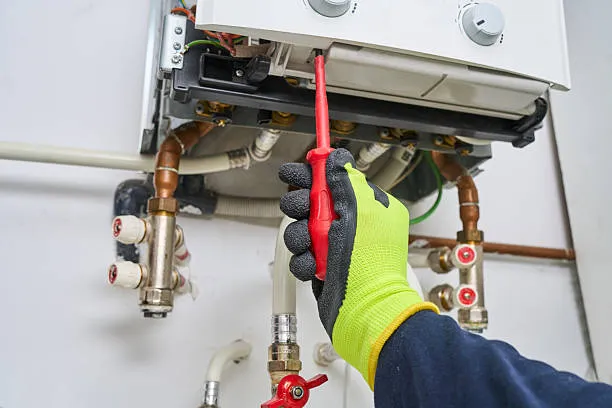
- Survey: An engineer checks your property, flue route, gas supply and mains water flow.
- Quote: You receive a written quote listing the boiler, parts and labour.
- Old boiler removal: The engineer drains the system and disconnects the old unit.
- New boiler fitting: The combi is mounted, connected to gas, water and heating pipes, and the flue is fitted.
- System cleaning and protection: The system is flushed, a magnetic filter is fitted and inhibitor is added.
- Commissioning: The engineer tests the boiler, checks combustion and sets up controls.
- Paperwork: You should receive a Benchmark commissioning checklist, and the installation should be notified to Building Control through the installer’s competent person scheme.
Legal and Safety Points
- Gas Safe registration is legally required. Ask to see the engineer’s Gas Safe ID card and check the register online.
- Building Regulations apply. Boiler installs in England must meet heating controls requirements, and your installer should notify the work.
- Carbon monoxide alarms should be fitted near the boiler and in sleeping areas.
- Flue rules: The flue terminal must be a safe distance from windows, boundaries and openings. This can be tricky in tight London terraces and flats.
Combi Boiler vs System Boiler: Which Is Better?
A combi is better for smaller homes with one bathroom. A system boiler is better for larger homes with two or more bathrooms and higher hot water demand.
| Feature | Combi boiler | System boiler |
|---|---|---|
| Hot water | On demand, no storage | Stored in a cylinder |
| Space needed | Minimal | Needs cylinder space |
| Simultaneous showers | Limited | Handles several |
| Hot water pressure | Mains pressure | Good with an unvented cylinder |
| Upfront cost | Often lower | Often higher (cylinder cost) |
| Works during a power cut? | No | Depends on the setup |
| Best for | Flats, 1 to 3 bed homes | Larger homes, 2+ bathrooms |
Simple rule of thumb: If your household rarely uses more than one hot outlet at a time, choose a combi. If several people shower back to back or at the same time, choose a system boiler.
Combi Boiler Running Costs
A modern combi boiler is very efficient and can be cheaper to run than an old boiler with a hot water cylinder. Running costs depend more on your gas price, your home’s insulation and how you use your heating than on the boiler type.
Why combis can be cheaper to run:
- No stored hot water: No tank to keep hot, so no standing heat loss
- Condensing efficiency: Modern models convert over 90% of gas into heat
- Heat only when you need it: Hot water is made on demand
Combi vs system boiler running costs: Both are similarly efficient at burning gas. The difference is in how water is heated. A combi avoids cylinder heat loss, but a well-insulated modern cylinder loses very little. Gas price and usage patterns matter far more than the boiler type.
Upgrading from an old boiler: Replacing an older, low-efficiency boiler (say 60% to 70% efficient) with a modern A-rated model with good controls can save hundreds of pounds a year in many homes.
Ways to lower your bills:
- Fit a smart thermostat or room thermostat with a schedule
- Use weather compensation if your boiler supports it
- Lower the boiler flow temperature (a good engineer can set this up)
- Add a magnetic filter and keep the system clean
- Bleed radiators and balance the system
- Improve insulation (loft, walls, draught-proofing)
- Service the boiler every year
For current gas rates, check Ofgem’s energy price cap, as unit prices change every quarter.
Common Combi Boiler Problems (and What They Mean)
The most common combi boiler problems are low pressure, no hot water, no heating, strange noises and ignition faults. Many have simple causes, but gas and internal repairs should only be done by a Gas Safe engineer.
| Problem | Likely cause | What you can do |
|---|---|---|
| Low pressure (below 1 bar) | Leak, recent bleeding | Top up using the filling loop if the manual allows. Repeated drops need an engineer |
| No hot water | Faulty diverter valve, blocked heat exchanger, limescale | Call an engineer |
| No heating, hot water fine | Diverter valve, pump, thermostat or controls | Check thermostat and programmer first, then call an engineer |
| Kettling (rumbling noise) | Limescale or sludge | Needs a service, and possibly a powerflush or descale |
| Boiler won’t ignite | Gas supply, ignition, faulty sensor | Check gas is on and the boiler is reset. If it repeats, call an engineer |
| Frozen condensate pipe | Cold weather freezes the pipe | Pour warm (not boiling) water over the pipe, then reset |
| Radiators cold at the top | Trapped air | Bleed the radiators |
| Radiators cold at the bottom | Sludge | System cleaning or powerflush |
Why hard water matters in London: London’s water is very hard. Over time, limescale can build up on the plate heat exchanger, which reduces hot water flow and boiler efficiency. A scale reducer, regular servicing and a magnetic filter all help protect the boiler.
Safety warning: If you smell gas, call the National Gas Emergency line on 0800 111 999 immediately. Open windows, don’t use switches or naked flames, and leave the property if needed.
Disadvantages of a Combi Boiler
The main disadvantages of a combi boiler are limited hot water for several outlets at once, dependence on mains pressure and no stored hot water during a fault.
Pros:
- Compact, no tank or cylinder
- Hot water on demand
- Usually lower installation cost
- Frees up loft and cupboard space
- Mains-pressure hot water for good showers
Cons:
- Can’t easily run two showers at once
- Flow depends on your mains pressure and pipe size
- No backup hot water if the boiler breaks down
- Not compatible with all older systems and some low-pressure homes
- Can’t feed an immersion heater as a backup
- Limescale is a concern in hard water areas like London
Is a combi boiler worth it? For a flat or small home with one bathroom, yes. For a large family home, a system boiler often serves better.
How Long Does a Combi Boiler Last?
A combi boiler typically lasts 10 to 15 years. Servicing, water quality and installation quality all affect how long it lasts.
Signs it’s time to replace your boiler:
- It’s over 12 to 15 years old
- Repairs are becoming frequent
- Parts are hard to find
- Your bills have crept up
- The heat exchanger is failing or leaking
- The boiler makes loud noises or produces poor hot water flow
- An engineer advises it’s beyond economical repair
How to extend its life:
- Service it once a year
- Fit a magnetic filter and clean it regularly
- Use inhibitor in the system
- Fix small faults early
- Keep the boiler pressure in the correct range
- In hard water areas, consider a scale reducer
A rough rule: if a repair costs more than about a third to a half of a new boiler, and your boiler is over 10 years old, replacement is usually the smarter choice.
Combi Boiler Servicing and Repair in London
A combi boiler should be serviced every 12 months by a Gas Safe registered engineer. Regular servicing keeps the boiler safe and efficient, and it’s usually required to keep the manufacturer’s warranty valid. Landlords in England must also have a gas safety check carried out every year.
What a service includes: checking the flue, burner, heat exchanger and seals, testing safety devices, and measuring combustion.
How to choose a good installer:
- Gas Safe registered (verify the ID card and the online register)
- Manufacturer-approved for extended warranties
- Clear written quotes with no vague “extras”
- Verified reviews and local references
- Public liability insurance
- Willingness to do a proper survey before quoting
Frequently Asked Questions
1. What size combi boiler do I need for a 2 bedroom house in London?
Most 2 bedroom houses with one bathroom need a 25kW to 30kW combi. If you have two bathrooms or a large household, consider 35kW or a system boiler.
2. What size combi boiler do I need for a 3 bedroom house in London?
A 3 bedroom house with one bathroom typically suits a 30kW to 35kW combi. With two bathrooms and simultaneous use, a system boiler is usually better.
3. What is the best combi boiler for a London flat?
For most flats, a 24kW to 30kW combi from a reputable brand with a long warranty is ideal. Choose based on hot water use, mains pressure and available space rather than brand alone.
4. Can a 30kW combi boiler run two showers?
Generally no. A 30kW combi delivers about 12 litres of hot water per minute, which is not enough for two standard showers together without a drop in flow or temperature.
5. Can a combi boiler supply two bathrooms at the same time?
It can supply two bathrooms, but not comfortably for two showers at once. It works well if the bathrooms are used at different times.
6. Is a combi boiler suitable for a London flat?
Yes. Combis suit most London flats because they’re compact, need no tanks and provide instant hot water. Check your mains pressure and any leasehold rules first.
7. How much does it cost to install or replace a combi boiler in London?
A like-for-like replacement typically costs £2,300 to £3,800. Moving the boiler or converting from a tank system can cost £3,000 to £5,500 or more.
8. How long does a new combi boiler installation take?
A standard replacement takes about one day. Relocating the boiler or converting the system usually takes two to three days.
9. Is a combi boiler cheaper to run than a system boiler?
Not necessarily. Both are similarly efficient. A combi avoids cylinder heat loss, but your gas price, insulation and heating habits have a bigger effect on bills.
10. Should I get a combi or a system boiler for my London home?
Choose a combi for a flat or small home with one bathroom. Choose a system boiler for larger homes with two or more bathrooms or high hot water demand.
Conclusion: Is a Combi Boiler Right for Your London Home?
For most London flats and small to medium homes, a combi boiler is an efficient, space-saving choice that delivers hot water on demand. The right size, a proper installation by a Gas Safe engineer and yearly servicing matter more than the brand. If you run several showers at once or have three or more bathrooms, a system boiler may suit you better.
Next step: Book a free survey with a Gas Safe registered engineer who will check your mains flow rate, recommend the right size and give you a written, fixed-price quote.